


Understanding Diamonds
Every diamond is unique, with its own combination of brilliance, proportions and individual characteristics. Understanding what makes one diamond different from another is an important part of choosing a stone that's right for you.
Whether you're exploring diamonds for an engagement ring or creating a bespoke piece of jewellery, our guide will help you understand the qualities that influence a diamond's appearance, quality and value.
The 4CS
Understanding the 4Cs of Diamonds
The 4Cs – cut, colour, clarity and carat weight – are the internationally recognised characteristics used to assess diamond quality.
Each plays a different role in a diamond's appearance and value. Understanding how they work together can help you make a more informed decision when choosing your stone.
-
Cut
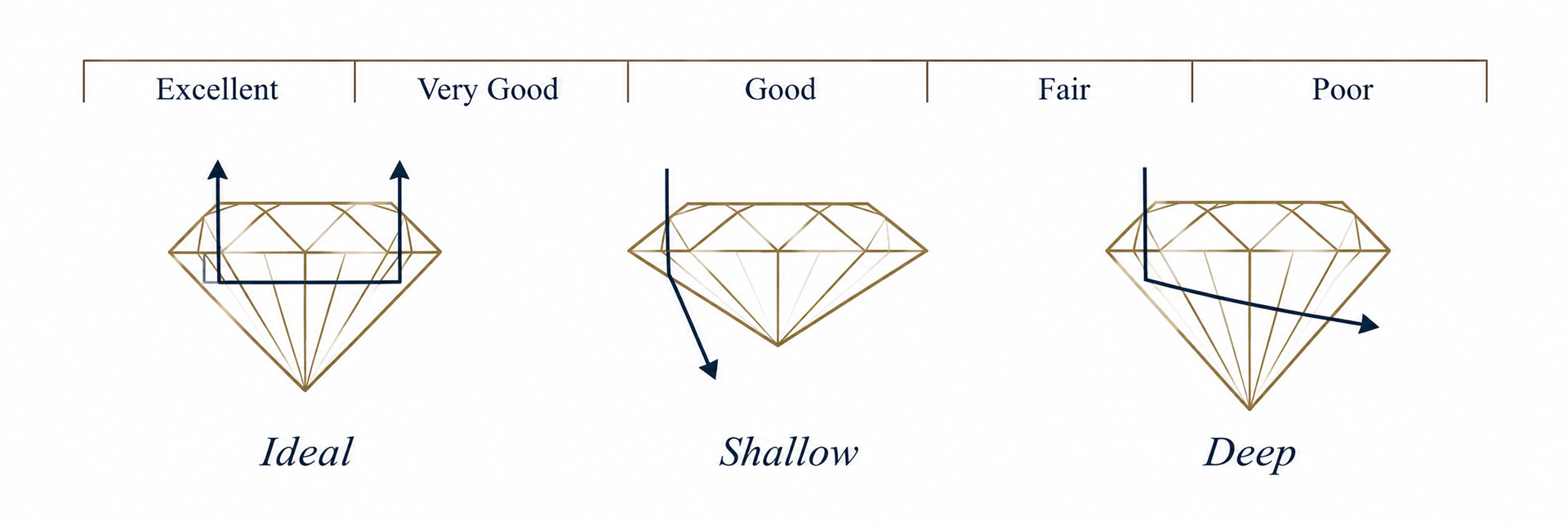
A diamond's cut is one of the most important factors influencing its sparkle. Rather than simply describing its shape, cut refers to how well a diamond's proportions, facets and finish work together to interact with light.
A beautifully cut diamond reflects light in a way that creates brightness, flashes of colour and sparkle as it moves. Even a diamond with exceptional colour and clarity can appear less lively if its cut is poorly proportioned.
For round brilliant diamonds, laboratories such as GIA assess cut quality using grades ranging from Excellent to Poor. For fancy-shaped diamonds, including oval, pear and emerald cuts, proportions, polish, symmetry and overall appearance are particularly important considerations.
-
Colour
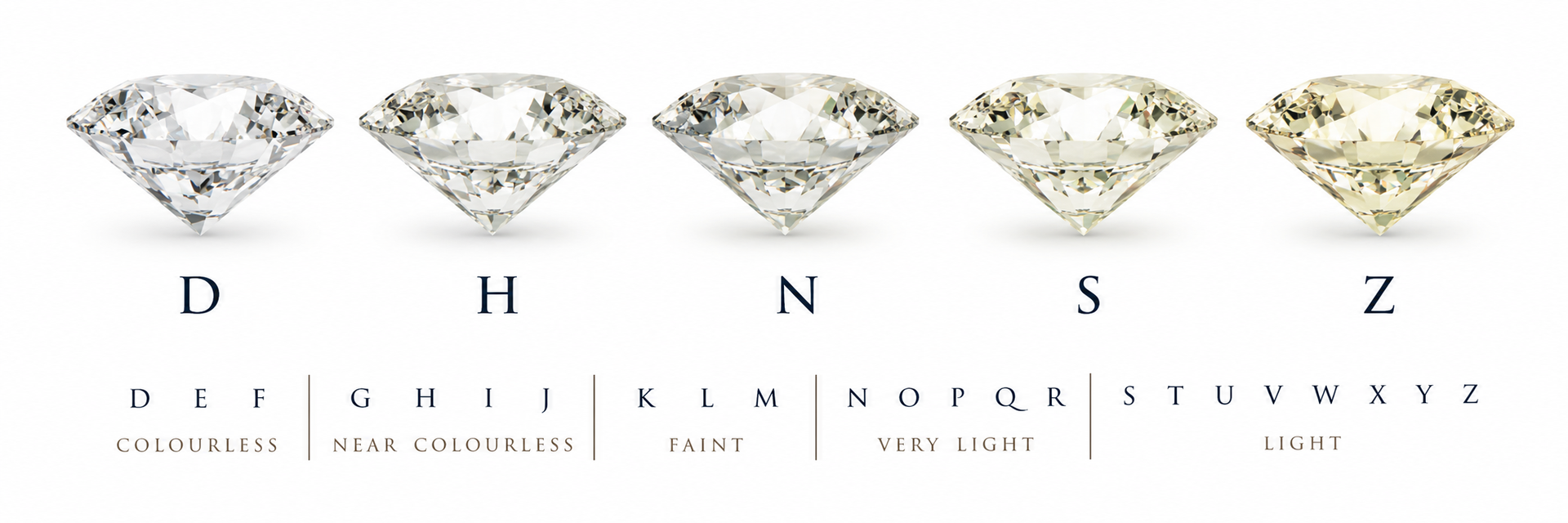
When discussing white diamonds, colour refers to the presence or absence of natural yellow or brown tones within the stone.
The GIA diamond colour scale ranges from D, representing colourless diamonds, through to Z, where light yellow or brown colouring becomes more noticeable.
Diamonds graded D to F are considered colourless, while G to J diamonds fall within the near-colourless category. Subtle differences between neighbouring grades can be difficult to distinguish without controlled lighting and comparison stones.
Although higher colour grades are generally rarer and more valuable, a slightly warmer diamond can still look beautiful, particularly when paired with a complementary metal setting.
Fancy coloured diamonds, including pink, blue and vivid yellow diamonds, are assessed using a different colour-grading system.
-
Clarity
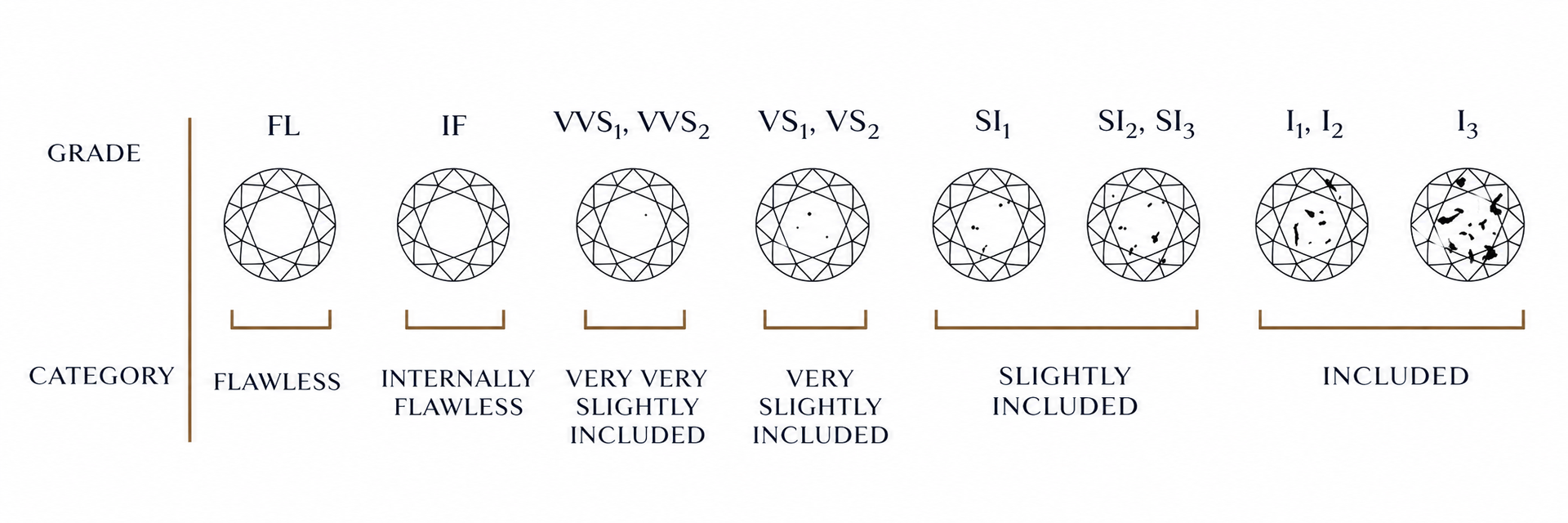
Clarity describes the presence of internal characteristics, known as inclusions, and external characteristics, known as blemishes.
Most diamonds contain some clarity characteristics, many of which are invisible to the naked eye. The traditional GIA clarity scale ranges from Flawless (FL) to Included (I), with grades determined through examination under 10× magnification.
A diamond doesn't need to be flawless to look beautiful. Many diamonds with lower clarity grades appear clear to the naked eye, offering an attractive balance between appearance and value.
The size, type and position of inclusions are all worth considering when choosing a diamond, particularly where they may affect its appearance or durability.
-
Carat Weight
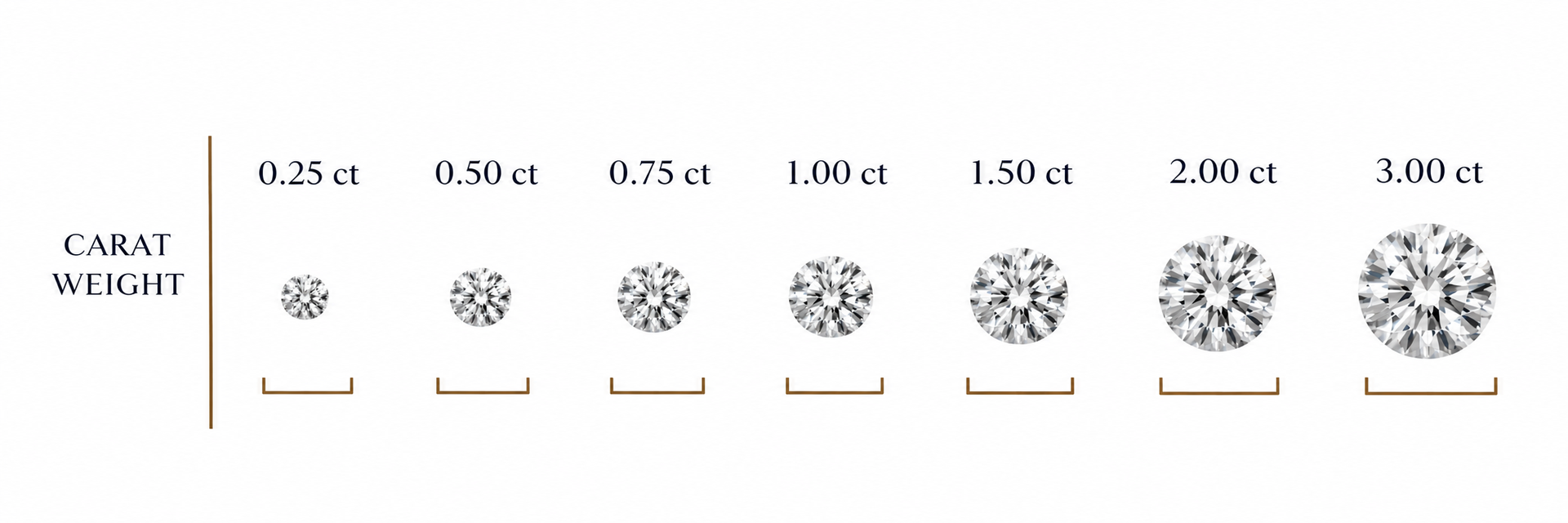
Carat is the unit used to measure a diamond's weight, with one carat equal to 0.2 grams.
Although often associated with size, carat weight doesn't directly determine how large a diamond will appear. Its shape, proportions and depth all influence its visible dimensions.
Elongated diamond shapes such as oval, pear and marquise cuts can appear larger from above than some other shapes of the same carat weight.
As diamonds increase in carat weight, their rarity and price can rise significantly, particularly when combined with desirable colour, clarity and cut characteristics.
Rather than focusing on carat weight alone, it's worth considering how the diamond looks as a whole and how its proportions complement your chosen jewellery design.
Choosing Quality
What Diamond Quality Should You Choose?
Choosing a diamond doesn't necessarily mean selecting the highest grade in every category. It's about finding the right balance between appearance, quality and budget.
What Diamond Cut Should You Look For?
For a round brilliant diamond, we'd generally suggest prioritising an Excellent cut grade, as this has a significant influence on the stone's brilliance and sparkle.
For other shapes, including ovals, pears and emerald cuts, it's important to look closely at proportions, symmetry and overall appearance rather than relying on a single cut grade.
What Diamond Colour Is Best?
For many white diamonds, near-colourless grades can offer a beautiful appearance without the additional cost associated with the very highest colour grades.
G to H colour can be a useful comparison point, although the right grade depends on the diamond's shape, size, metal setting and your personal preference.
At Swales Diamonds, our natural diamond selection standards begin at F colour, allowing us to offer customers a particularly bright, colourless starting point.
What Diamond Clarity Should You Choose?
A diamond doesn't need to have a Flawless clarity grade to appear beautiful.
VS1 and VS2 diamonds are often worth considering when balancing clarity and value, while carefully selected SI1 diamonds may also appear eye-clean.
At Swales Diamonds, our natural diamond selection standards start at SI1 clarity, with each stone assessed individually.
We consider the position and visibility of inclusions, alongside the diamond's overall appearance, rather than relying on the grading report alone.
Should You Prioritise Carat Weight or Quality?
There's no single answer, as it depends on what matters most to you.
If you're drawn to a larger diamond, choosing different colour or clarity grades may allow you to increase the carat weight while maintaining a beautiful overall appearance.
Alternatively, a slightly smaller diamond with excellent proportions and light performance can be equally striking.
The aim is to find the best combination of size, appearance and quality for your preferences and budget.
EXPLORE THE SHAPES
Explore Diamond Shapes
The shape of a diamond is one of its most distinctive features, influencing the overall appearance and character of a piece of jewellery.
From the timeless round brilliant to elegant elongated shapes and geometric step cuts, each offers something different.
-
Round Diamonds
The round brilliant is the most traditional and widely recognised diamond shape, celebrated for its exceptional sparkle.
Its carefully arranged facets are designed to maximise light performance, creating a beautiful combination of brilliance and fire. Timeless and versatile, round diamonds complement almost every setting, from classic solitaires to more intricate designs.
-
Oval Diamonds
Oval cut diamonds combine the brilliance of a round diamond with a softly elongated silhouette.
Their elegant proportions can create the appearance of a larger stone and give a flattering, lengthening effect when worn on the finger. Equally suited to modern and traditional settings, oval diamonds have a timeless appeal.
-
Emerald Cut Diamonds
Known for their clean lines and understated elegance, emerald cut diamonds feature a rectangular shape with cropped corners and long, step-cut facets.
Rather than producing the lively sparkle of a brilliant cut, they create broad flashes of light and a distinctive hall-of-mirrors effect. Their open facet structure also makes clarity an important consideration.
-
Princess Cut Diamonds
With their square shape and brilliant-style faceting, princess cut diamonds offer a contemporary alternative to the classic round brilliant.
Their sharp corners create a defined, geometric silhouette, while their faceting produces plenty of sparkle. Princess cuts work beautifully in both simple solitaire settings and more detailed designs.
-
Cushion Cut Diamonds
Cushion cut diamonds are recognised by their softened corners and gently rounded square or rectangular shape.
With origins in traditional diamond cutting, this shape has a romantic, vintage-inspired character. Different faceting styles can create everything from broad flashes of light to a finer, more delicate sparkle.
-
Radiant Cut Diamonds
Radiant cut diamonds combine the elegant outline of an emerald cut with the lively sparkle of brilliant-style faceting.
Typically rectangular or square with cropped corners, they offer a balance between clean lines and brilliance. Their versatility makes them a beautiful choice for contemporary engagement rings.
-
Pear Cut Diamonds
The pear cut brings together a rounded end and a delicate point to create its distinctive teardrop shape.
Elegant and slightly unconventional, pear shaped diamonds can be worn in different orientations and often create a lengthening effect on the finger. Their silhouette makes them particularly striking in solitaire and bespoke designs.
-
Marquise Cut Diamonds
Marquise cut diamonds feature an elongated shape with gracefully curved sides and pointed ends.
Their distinctive silhouette creates a lengthening effect, while their generous face-up proportions can make them appear larger than some other shapes of the same carat weight.
Marquise diamonds are particularly beautiful in both vintage-inspired and contemporary designs.
-
Asscher Cut Diamonds
The Asscher cut is recognised by its square shape, cropped corners and symmetrical step-cut facets.
Its geometric structure produces a distinctive hall-of-mirrors effect, with flashes of light that feel more understated than brilliant-style sparkle.
With its Art Deco associations and architectural appearance, the Asscher cut is especially suited to vintage-inspired and minimalist jewellery.
-
Heart Shaped Diamonds
The heart shaped diamond is one of the most romantic and distinctive diamond cuts.
Its symmetrical outline and brilliant-style faceting combine meaningful symbolism with sparkle. Achieving a well-balanced shape is particularly important, making symmetry a key consideration when choosing a heart shaped diamond.
SHAPE AND SIZE
Does Diamond Shape Affect How Big It Looks?
Yes. Two diamonds of the same carat weight can look noticeably different in size depending on their shape and proportions.
Elongated shapes such as oval, pear and marquise cuts often appear larger when viewed from above, while deeper-cut diamonds may carry more of their weight below the visible surface.
For example, a well-proportioned 1 carat round brilliant diamond typically measures approximately 6.4–6.5mm across, while a 1 carat oval diamond may have a longer face-up outline.
This is why it's worth considering a diamond's measurements alongside its carat weight, particularly when comparing different shapes for an engagement ring.

DIAMOND ANATOMY
Understanding Diamond Anatomy
A diamond's anatomy refers to the different parts that make up its structure. Each plays a role in its proportions, appearance and interaction with light.

Table
The large, flat facet at the top of the diamond.
Crown The upper section, extending from the table to the girdle.
Girdle The narrow outer edge separating the crown from the pavilion.
Pavilion The lower section of the diamond, extending beneath the girdle.
Culet The small point or facet at the very bottom of the diamond, depending on its design.
The relationship between these elements influences how light travels through the stone, contributing to its brightness, fire and overall visual appearance.
Natural and Lab-Grown
Natural and Lab-Grown Diamonds
Natural and lab-grown diamonds share the same essential chemical composition and crystal structure. Both are genuine diamonds, with the same fundamental optical and physical properties.
The primary difference lies in how they are created.
Natural diamonds form deep within the Earth over immense periods of geological time, while lab-grown diamonds are produced using specialist technology that enables diamond crystals to grow under controlled conditions.
Both are available in a variety of shapes, sizes and quality characteristics, and both can be used to create bespoke jewellery.

Are Lab-Grown Diamonds Real Diamonds?
Yes. Lab-grown diamonds are genuine diamonds, not imitations. They have essentially the same chemical composition, crystal structure and optical properties as natural diamonds.
They are different from diamond simulants, such as cubic zirconia and moissanite, which may look similar but have different compositions and properties.
Can You Tell the Difference Between Natural and Lab-Grown Diamonds?
Natural and lab-grown diamonds can appear identical to the naked eye.
Distinguishing between them reliably may require specialist testing equipment or examination by a gemmological lab.
Are Lab-Grown Diamonds Cheaper Than Natural Diamonds?
Lab-grown diamonds are generally less expensive than natural diamonds of comparable size and quality.
This can allow you to explore a larger stone or different quality characteristics within the same budget.
Natural diamonds, meanwhile, are valued in part for their geological origin and rarity.
At Swales Diamonds, we offer both natural and lab-grown diamonds, allowing you to compare the options and choose what matters most to you.
Diamond Prices
DIAMOND PRICES
How Much Does a Diamond Cost?
The price of a diamond depends on several factors, including its carat weight, cut, colour, clarity, shape and whether it is natural or lab-grown.
Larger diamonds are generally more expensive, particularly when combined with higher quality grades. However, two diamonds of the same carat weight can differ significantly in price.
How Much Does a 1 Carat Diamond Cost?
There isn't one fixed price for a 1 carat diamond.
A natural 1 carat diamond will generally cost more than a lab-grown diamond of comparable characteristics, while differences in colour, clarity, cut and proportions can also influence the price.
The best way to understand these differences is to compare diamonds with similar specifications and consider how their individual characteristics affect both appearance and value.
At Swales Diamonds, we can help you explore different options and find a diamond that suits your preferences and budget.


Grading Reports
Understanding Diamond Grading Reports
A diamond grading report provides an independent assessment of a diamond's characteristics, helping you understand exactly what you're choosing.
Recognised gemmological laboratories, including GIA and IGI, provide reports or assessments containing information about diamond quality and identification.
For natural diamonds, reports typically include carat weight, colour, clarity and measurements. Depending on the diamond and lab, they may also include cut grade, polish, symmetry, fluorescence and clarity characteristics.
Lab-grown diamond reporting can differ between laboratories. For example, GIA's current lab-grown diamond assessment service uses descriptive quality categories rather than its traditional natural-diamond grading terminology.
A grading report helps you compare diamonds, but the grades alone don't always tell the full story of how an individual stone will look.
Seeing a diamond in person and considering its overall appearance remains an important part of the selection process.
Care and Maintenance
Caring for Your Diamond Jewellery
Diamonds are exceptionally hard and resistant to scratching, but they are not indestructible. A strong impact can damage a diamond, while everyday wear can affect its setting.
Suitable diamond jewellery can often be cleaned gently using warm water, mild washing-up liquid and a very soft brush. However, delicate settings, loose stones and jewellery containing other gemstones may require specialist care.
Regular professional inspections are also recommended to ensure claws and settings remain secure.
For more detailed cleaning, storage and maintenance advice, explore our Jewellery Care Guide.
Buying a Diamond
What Should You Look for When Buying a Diamond?
When choosing a diamond, it's worth looking beyond its carat weight or grading report. Considering a few key details can help you find a stone that offers the right balance of beauty, quality and value.
- Cut and proportions: Look for a diamond with strong light performance and proportions that complement its shape.
- Colour and clarity: Consider how the diamond looks to the naked eye, rather than focusing solely on achieving the highest grades.
- Carat weight and measurements: Compare the physical dimensions of different diamonds, as stones of the same carat weight can appear different in size.
- Grading reports: Check the diamond's assessment from a recognised gemmological lab and understand the characteristics recorded.
- Natural or lab-grown: Consider which option best suits your personal preferences and budget.
- Setting and lifestyle: Think about how the diamond will be worn and whether its shape and setting are suitable for everyday use.
At Swales Diamonds, we can guide you through each of these considerations and help you compare individual diamonds before making your decision.
PERSONAL GUIDANCE
Find Your Perfect Diamond
Choosing a diamond is about finding the right balance of beauty, quality and personal preference.
Whether you have a particular shape in mind or are just beginning to explore your options, our team can help you compare different stones and understand which characteristics are most important for your design.
Visit our Birmingham Jewellery Quarter boutique for a complimentary, no-obligation consultation and discover the possibilities for your bespoke jewellery.
